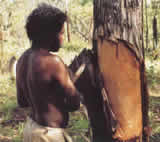
The bark used for bark paintings is cut from the
stringybark tree (Eucalyptus tetrodonta). The bark is cut from the
tree during and immediately after each Wet Season when it is moist
and pliable, starting in December and going through until April or
May. It must be free of knots, splits or termite damage.
The painter cuts around the trunk, through the bark
and then tears off a rectangular piece. When first removed, the
bark is rough and curls round, still holding the shape of the
tree, and needs to be smoothed and flattened out. The outer layer
is roughly trimmed with an axe and the bark is then scraped until
smooth. |
|
To flatten the bark, a fire is first made and burned
down to hot coals of the right temperature. The wet bark is placed
on the coals and pressed flat, with the outside rough surface in contact
with the heat. Most of the moisture is driven out and the bark slowly
unbends. The surface to be painted does not come into contact with
the fire. The bark is then pressed flat for several days under weights.
Finally, sticks are tied tightly across both ends with string in order
to prevent warping. The surface is then ready to be painted.
The bark painters of Arnhem Land mainly work with four basic colours:
red black, yellow and white, although sometimes the primary colours
are mixed to give a pink, orange or grey. Red and yellows come from
a variety of iron ochres including hematite, ironstone and limonite.
White is generally gypsum or pipeclay and black is made from manganese
ore or charcoal. The pigments are ground finely and mixed with water
and vegetable fixatives. The most common natural fixative is the gum
or resin from local trees. Nowadays the artists more frequently use
a commercial acrylic binder.










 Bark
Painting Techniques
Bark
Painting Techniques